 |
|
|
 |
 |
||
| AtoZ Fitness Weekly Newsletter Jun.3 2008 Edition |  |
 |
||||

 In this
Jun.03 2008
issue:
In this
Jun.03 2008
issue:
|
|
|
|
| ||
|
Sarah's Introduction: | |
| |||
| ||||||
|
| |||||
|
Best ways to trainThat’s not a typo in the title, I did mean best ways and not best way. Because there is no one way to train optimally. Or … there is. Confused? Good So many trainers and "gurus" are telling us that their way is the way, the only way you’ll ever … burn fat, build muscle, etc. Some of them are just repeating something they’ve read in a magazine, some have really tried the program they claim is the one to end all search for your solution. However, they are all wrong, to a degree. There is no universal program that will truly end all search. What works well for one person, may not do a d***d thing for the other; or at best give them slower and weaker results, which is of course, discouraging! Where you will have the best chance at finding the right program for you, which is what you want after all, is when you find the program inventor/discoverer or whatever you want to call them, who was at a similar point in life to where you are now, before they changed to become the person you admire today. Let’s say you’re a scrawny person, the kind that cannot seem to put on any weight no matter what you do. If you like the looks of an internet "guru" you will be tempted to follow their advise, right? But make sure you follow the advise of one who was a scrawny "before" person (Jeff Anderson being one of those), not the former fatty! The same goes if you are now overweight or obese. Look for a "guru" who used to be overweight or obese themselves before they developed their program and look as fabulous now as you want to look by your goal date (Such as Jon Benson). You may still not find the optimal program for your body, your ambition, your lifestyle. Don’t be afraid to shop around a little, look at other programs as well. Your body adapts, it gets used to what you ask of it. After a year, the program that worked perfectly may no longer be the best thing for you, or you want to have two programs to switch between every 6 months or so. When you get the "HIIT or nothing" cardio pushers vs. the "steady state cardio is the only way" they are in fact both right; it just depends on how their bodies work and accept the different cardio training. It’s a little more complicated than that really, but just to keep it simple for now, I’ll put it down to body-type and previous training experience. What the HIIT-guys probably don’t think about either, is that everyone can’t do those spurts they ask for - not necessarily because their hearts or lungs can’t handle the pace, but the bladders could have that stress related leak problem, and running certainly is not an option in that case. The same thing could well be the case with weight programs. It’s not because one says to use only circuit training or the other says to use as heavy a weight as you can and rest between sets, that either is right or wrong. These are just different routines, different ways of targeting the muscles and tricking them into adding strength and size. Some of the exercises you may not be able to do, either physically or mentally (and by that I mean that you can’t seem to get the mind-muscle connection from an exercise), but there are always alternative exercises for any body part. The "guru’s" claim that you must use only the exercise chosen in the program … don’t let it phase you and keep you from doing that program if there is just one or two exercises you feel you need to switch, it’ll still work! In light of all this, why am I then doing Combat The Fat, since it’s designed by an ex-army guy and a hard-gainer, when I’m an ex-couch-potato and gain easily? Good question. Reason nr one, good old female curiosity Reason nr two, the guy is over 40 and had added some "winter fat" all of a sudden, and he used this program to burn it off, so it could work on me too. Reason nr three, the army gets all kinds of people in as recruits, hard gainers, people who gain (fat) easily, all three -morph types, so it had to work, right? Well, it does. I’m jealous Lewis has a 4-pack already! In just 6 weeks, he gets a 4-pack! I know, men and their testosterone, right? They drop that bodyfat faster, the pack on muscle faster, and as a result look better/good faster. The pictures tell me I’m looking better than on day 1, which is obviously why I say this program works; and there are 6 weeks left till the challenge dead-line. I am confident that I’ll at least have a shadow of a 4-pack by then! (so there!) In any case, if you do opt for a 12-week challenge - almost every program has them, especially in spring - remember that life does not stop after those 12 weeks. You may not win the challenge itself, but you will have won your own self respect and admiration ("hey, I can do this! I work out regularly, eat clean, and I’ve dropped x-nr of lbs of fat or gained so many of muscle"!). Don’t stop because the challenge is over!! My plan is to keep it up for 13 weeks in fact, then take a week off (possibly doing the EODD detox, not sure yet) and start up again for another 13 weeks of the same Combat The Fat program before taking two weeks off. By then, we’ll be mid-October, and I have no idea what I’ll be doing after those two weeks off while my parents are visiting from Europe, but I do know I won’t just sit on the couch all winter! BFFM? Jon Benson’s new program to be launched next week? I have NO idea right now, but I’ll let you know when the time comes! The message I’m trying to get across is basically to shop around for a couple of programs that suit you; then stick to them, switching between one and the other to ward off boredom and keep your muscles "guessing" at what’s going to hit them next. You can also mix and match programs … pick the EODD for the nutrition part, especially if you don’t feel like calculating and weighing and doing more maths than cooking; use CTF for the fat burning training; switch to BFFM for winter training or keep CTF until you have the bodyfat levels where you want them … it’s up to you. You will be the one designing the perfect program for you! You are the one who knows you best, so listen to you and take care of you while you’re still there to do it! Never mind what you did before, how you erred and messed up and got to the out-of-shape state you’re in (assuming you are). You build the future starting now, the past is … well, gone really isn’t it!? So forget it, or learn from it and move on to better ways and better days! Check out www.atozfitness.com for all programs we have tested and trust. Remember there are a number of free e-book downloads by the same authors as the programs, so you can have a sneak-peek into their way of thinking and explaining before you decide who you want to give your trust to. Oh, and you don’t have to have a female trainer if you’re female and male if you’re male … a muscle will respond just as well regardless of trainer gender! The main difference I’ve found, is that many "female programs" are too soft in the approach; which is why Karen Sessions is on the AtoZ page … nothing overly soft about that Iron Doll There is a free download of hers on the page; as well as one from Jon Benson on cardio, and a chapter by Tom Venuto from the old All Stars e-book if you sign up for the AtoZ Fitness Newsletter; so yes, you can find your program or combination of programs, knowing they are not there to fill up a web page, but to give you the best choice possible when you decide to make that lifestyle change or look to find a plateau breaker, or just variation. And if you feel you need someone to be accountable to, or you want help setting up the whole program, I’m just a click or two away at www.trainwithsarah.com Most important though: have fun with it !!
Train with a smile on your face, it makes it easier!! | ||||||
|
| |||||

|
|
|
|
| ||
|
Featured Fitness Article: | |
| |||
| ||||||
|
|
| |||||
|
Adaptations To Sprint Training
Click-Here to visit Vince Delmonte's site and get all of the
following f.ree gifts. ----------------------------------
| ||||||
|
| |||||

|
|
|
|
| ||
|
Unconventional Iron with Nick Nilsson:: | |
| |||
| ||||||
|
|
| |||||
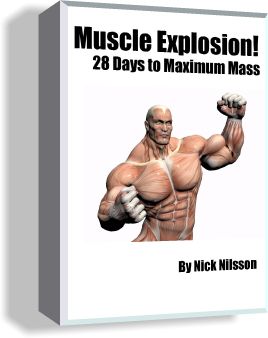
Using HIGH Reps To Build Muscle? Three Ways To Do It That Will Shatter ANY Muscle Growth Plateau!By Nick Nilsson
Normally, when
you think "muscle," you probably think "low reps"...but I've got
In fact, when trying to build muscle, most trainers will actively stay FAR away from anything resembling high reps (and when I say high reps, I mean anything more than 13 to 15 reps per set). Here's the thing...that can actually be a HUGE mistake! Just like heavy weights and low reps, the higher rep ranges can be a VERY valuable and even ESSENTIAL tool in your muscle-building arsenal. I've got three high-rep training techniques I want to share with you right now. And I'm going to explain EXACTLY why each one is critical to your muscle-building success.
| ||||||
|
| |||||
|
|
|
|
| ||
|
Newsletter Sponsor recommended by AtoZfitness.com: | |
| |||
| ||||||

5 Facts You MUST Understand if You Are
Ever Going to
Lose Your Belly Fat & Get Six Pack Abs
by Mike Geary - Certified Nutrition Specialist, Certified Personal Trainer (CPT) 1. Many so-called "health foods" are actually cleverly disguised junk foods that can actually stimulate you to gain more belly fat... yet the diet food marketing industry continues to lie to you so they can maximize their profits. 2. Ab exercises such as crunches, sit-ups, and ab machines are actually the LEAST effective method of getting flat six pack abs. We'll explore what types of exercises REALLY work in a minute. 3. Boring repetitive cardio exercise routines are NOT the best way to lose body fat and uncover those six pack abs. I'll tell you the exact types of unique workouts that produce 10x better results below. 4. You DON'T need to waste your money on expensive "extreme fat burner" pills or other bogus supplements. I'll show you how to use the power of natural foods in more detail below. 5. Ab belts, ab-rockers, ab-loungers, and other infomercial ab-gimmicks... they're all a complete waste of your time and money. Despite the misleading infomercials, the perfectly chiseled fitness models in the commercials did NOT get their perfect body by using that "ab contraption"... they got their perfect body through REAL workouts and REAL nutrition strategies. Again, you'll learn some of their secrets and what really works below.
So,
Click-Here and let's set the
|
| |||||
|
| |||||
|
|
|
|
| ||
|
Nicole Kuhl Transformation from the inside out : | |
| |||
| ||||||
|
WILLPOWER GENE Last week I read an article entitled the Willpower Gene. According to research conducted at State University of New York at Buffalo, overeating has been linked to a gene involved in alcoholism and drug addiction. People who carry a certain variant of the gene were at the highest risk for overindulging in snacks, compared with subjects who did not have the gene. According to this study, 30-40% of the population have this gene. This gene is linked to a deficiency in the reward pathway in the brain. People with the gene must engage in more of a behavior to get the same amount of pleasure as those without the gene. My take on this research: The impact of genetics cannot be denied; however, lifestyle can override genetic predispositions. The foods you eat literally change your DNA. Nutrients found in health foods have the potential to positively impact gene expression. On the flip side, anti-nutrients cause free radicals and damage DNA. Many people get caught in a cycle of eating the wrong kind of foods which causes elevations in blood sugar and disruptions in brain chemistry, making it impossible to eat normally. Even seemingly healthy foods (rice cakes, pretzels, granola bars) can set you up for overeating. It is important to eat a diet which stabilizes both blood sugar and brain chemistry in order to combat overeating. The first thing that came to mind when I read this article was an alcoholic. Alcoholics would surely possess the variant of this gene. Another thing that came to mind was a recovered alcoholic. If someone who suffered from hopeless alcoholism can become completely abstinent, a person suffering from overeating can certainly recover as well. Overeaters anonymous is wonderful group that has helped thousands of people recover from overeating. Lastly, strategy is more effective than willpower. In the weight management program I facilitate, I teach ways to incorporate diet strategy. If you would like information on these strategies, simply contact me at nicole.kuhl@comcast.net
|
| |||||
|
------------------------------------------------------------------------------------------------
| ||||||
|
| |||||
 Nicole
Kuhl -Transformation From The Inside Out
Nicole
Kuhl -Transformation From The Inside Out
|
|
|
|
| ||
|
GHF Weekly Featured Recipe: | |
| |||
| ||||||
|
|
| |||||
|
Fruit Salad Makes: Ingredients:
Directions:
Nutritional Information:
------------------------------------------------------------------------------------------------------------------------------------------------ by the President of Global-Fitness GHF offer's two membership options: a 30-day limited Trial for $9.95 or three months of Full Membership for $59.99, which includes everything listed below! But as an AtoZ Fitness subscriber, for a limited time, you can take advantage of one of these two amazing Special Offers:
| ||||||
|
| |||||
|
|
|
|
| ||
|
Photos_by_jae* | |
| |||
| ||||||
|
The newsletter now features inspiring and motivational photos of some of today's top bodybuilders and leading fitness models. Provided by : www.zazzle.com/photos_by_jae*
|
| |||||
|
| |||||

|
|
|
|
| ||||||||||||||||||||||||
|
AtoZfitness Page Supporters: | |
| |||||||||||||||||||||||||
| ||||||||||||||||||||||||||||
|
|
| |||||||||||||||||||||||||||
| ||||||||||||||||||||||||||||
|
| |||||||||||||||||||||||||||
|
|
|
|
| ||
|
AtoZ Fitness and You: | |
| |||
| ||||||
|
|
| |||||
|
The fine print..... -If you are the author of an interesting fitness/health related article and would like to share it with thousands of people please see http://www.atozfitness.com/submit-article.html for submission details. We are always looking for new content for our atoz visitors. If you wish to sponsor this weekly newsletter please visit http://www.atozfitness.com/advertise/indexnf.html for our sponsorship rate plan. ©AtoZfitness 2008 | ||||||
|
| |||||
* * * Un-subscription Link Details Below * * *
I sincerely hope you Enjoyed
this edition of our newsletter BUT
If you wish to To Un-Subscribe from the AtoZfitness
Newsletter.
Please Click-Here.
PLEASE DO NOT REPLY to this email. Replies to this
email account are not reviewed by our team and any reply will be
automatically deleted. If you wish to unsubscribe please use the link
above.
AFFILIATE PROGRAM MAKE MONEY WITH YOUR FITNESS RELATED WEBSITE